Tuesday, November 3, 2009

2010 Scholarships for Military Children Program opens TODAY!

October 29, 2009
By Tammy L. Moody,DeCA marketing and mass communication specialist

FORT LEE, Va. – The holidays are fast approaching, and they can be a fun family time as children away at college come home, and other students get their holiday break. It’s also a time for students and parents to apply for the 2010 Scholarships for Military Children Program that opens in November.

Scholarship applications will be available Nov. 3 in commissaries worldwide and online through a link at https://www.commissaries.com and directly at http://www.militaryscholar.org. Since the program began in 2000, it has awarded $7.3 million in scholarships to almost 5,000 children of service members.

The Nov. 3 scholarship kickoff coincides with National Military Family Month, and is an example of commissaries supporting their local communities by helping to improve the quality of life for military families, said Defense Commissary Agency Director and CEO Philip E. Sakowitz Jr.

“Being part of something that makes higher education more affordable for military families is thrilling, as we feel it makes a better future possible for their children,” he said. “The program awards $1,500 scholarships to well-rounded, accomplished service members’ children, enabling these families to save some on their children’s tuition.”

Only dependent, unmarried children, younger than age 21 (age 23 if enrolled as a full- time student at a college or university) of active duty personnel, Reserve, Guard and retired military members, survivors of service members who died while on active duty, or survivors of individuals who died while receiving retired pay from the military may apply for a scholarship. Eligibility is determined using DEERS, the Defense Enrollment Eligibility Reporting System database. Applicants should ensure that they, as well as their sponsor, are enrolled in the DEERS database and have a current ID card. The applicant must be planning to attend, or already be attending, an accredited college or university full time in the fall of 2010, or be enrolled in a program of studies designed to transfer directly into a four-year program.

Applicants should prepare to submit an essay on the following topic: “You can travel back in time; however, you cannot change events. What point in history would you visit and why?” Applications must be turned in to a commissary by close of business Feb. 17. At least one scholarship will be awarded at every commissary location with qualified applicants.

The scholarships program is administered by Fisher House Foundation, a nonprofit organization that provides assistance to service members and their families. Scholarship Managers, a national, nonprofit, scholarship management services organization, manages and awards the scholarships. Commissary vendors, manufacturers, brokers, suppliers and the general public donate money to the program, and every dollar donated goes directly to funding the scholarships.

Check us out on the Web: http://www.commissaries.com, http://www.facebook.com/pages/Defense-Commissary-Agency/131694158961?ref=ts and http://twitter.com/TheCommissary
About DeCA: The Defense Commissary Agency operates a worldwide chain of commissaries providing groceries to military personnel, retirees and their families in a safe and secure shopping environment. Authorized patrons purchase items at cost plus a 5-percent surcharge, which covers the costs of building new commissaries and modernizing existing ones. Shoppers save an average of more than 30 percent on their purchases compared to commercial prices – savings worth about $3,300 annually for a family of four. A core military family support element, and a valued part of military pay and benefits, commissaries contribute to family readiness, enhance the quality of life for America’s military and their families, and help recruit and retain the best and brightest men and women to serve their country.

Monday, November 2, 2009

Norfolk Zoo-Boo 2009

I'll be honest, I was not that impressed. After already being PAYING members of the zoo, we had to pay another $4 per person ($12 for our family) to JUST to get into the zoo... This is what I don't understand... It usually costs $7 for non members to get into the place... They were charging $8 for this event... So then why were members essentially charged more, $4? Why not the dollar difference? See what I'm saying?

I just don't see what the draw is... Yeah the animals seemed more active then usual because the zookeepers had been throwing pumpkins into their cadges... And yeah my kid got SOME halloween candy... But not enough to make up for that extra $12 we had to pay... I'm kinda unsure where those extra entrance charges were going... Then my daughter spotted the bounce houses... And of course they were charging an additional dollar for that... So she went in there and bounced for all of 5 minutes... Then she HAD to feed the goats, whish was another dollar for food... And then the zoo-boo-choo-choo... Ugh... It's usually $2 a rider... Which is $2 too much in my opinion... But of course they were charging EVEN MORE to ride it during this event ($3)... And of course my daughter just HAD to go on it... So there was another $9 down the whole... All together we wound up forking out $23 for 2 hours of entertainment... For something that shouldn't have cost us anything... Lame... Well I guess you live and lean... I just wouldn't recomend this event to anyone.

Barbecued Seitan Ribz

1 cup vital wheat gluten
2 teaspoons smoked Spanish paprika
2 tablespoons nutritional yeast
2 teaspoons onion powder
1 teaspoon garlic powder
3/4 cup water
2 tablespoons tahini or other nut butter
1 teaspoon Liquid Smoke
1 tablespoon soy sauce
about 1 cup of your favorite barbecue sauce

Preheat the oven to 350 and lightly spray an 8x8 baking dish with canola oil. Mix the first 5 ingredients together in a large bowl. Mix the water with the nut butter, Liquid Smoke, and soy sauce and add it to the dry ingredients. Stir to mix well and then knead lightly in the bowl for a couple of minutes.

Put the dough into the baking dish and flatten it so that it evenly fills the pan. Take a sharp knife and cut it into 8 strips; then turn the pan and cut those strips in half to form 16 pieces:

Barbecued Seitan Ribz

Put it in the oven and bake for 25 minutes. While it's cooking prepare your grill.

Remove it from the oven and carefully re-cut each strip, going over each cut to make sure that the ribz will pull apart easily later. Generously brush the top with barbecue sauce. Take it to the grill and invert the whole baking dish onto the grill (or use a large spatula to lift the seitan out, placing it sauce-side down on the grill). Brush the top of the seitan with more sauce:

E brushing bbq sauce on Seitan Ribz

Watch it closely to make sure that it doesn't burn. When it's sufficiently brown on one side, turn over and cook the other side, adding more sauce, if necessary. When done, remove to a platter and cut or pull apart the individual ribs to serve.

Barbecued Seitan Ribz

Sunday, November 1, 2009

Vegetable Lasagna Alfredo

Ingredients

* 2 cups carrot, thinly sliced
* 2 cups zucchini, thinly sliced
* 8 ounces mushroom, sliced
* 2 tablespoons olive oil
* 3 garlic clove, pressed
* 3/4 teaspoon dried thyme
* 1/4 teaspoon black pepper
* 1 (14 1/2 ounce) can Italian-style diced tomatoes
* 1 (15 ounce) container ricotta cheese
* 1 egg
* 1/4 cup grated fresh parmesan cheese
* 1 (16 ounce) jar white alfredo sauce (use a good quality brand,or make your own)
* 3/4 cup milk
* 10 uncooked lasagna noodle
* 3 cups shredded mozzarella cheese

Directions

1. Preaheat oven to 350.
2. Heat oil in large skillet. Saute garlic, sliced vegetables, thyme, and pepper, until vegetables are crisp/tender(about 7 minutes).
3. Remove from heat and add drained tomatoes, set aside.
4. Combine ricotta cheese, egg and parmesan in separate bowl.
5. In another bowl, mix alfredo sauce and milk until smooth.
6. To assemble;spread 3/4 cup of alfredo sauce mixture in bottom of 9x13 pan. Top with half of the uncooked noodles, pressing noodles into sauce. Spread with half of the ricotta mixture, top that with half of the vegetable mixture, then half of the mozzarella cheese. Repeat layers beginning with 3/4 cup of sauce.
7. Pour remaining sauce over final layer. Cover with foil.
8. Bake 50 minutes, uncover and continue baking for 10 minutes.
9. Remove from oven, let stand for 15 minutes before serving.

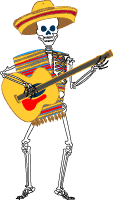
El Día De Los Muertos!

History
November first begins the Dia de los Muertos (also known as "Day of the Dead") festivities with
All Saints Day in which the deceased children are honored and remembered. November second All Souls Day is for the remembrance of the adult dead. Dia de los Muertos combines these days to celebrate the the deceased and enjoy their memories. Dia de los Muertos is not at all scary, spooky or somber. The spirits of the deceased are thought to pay a visit to their families during Dia de los Muertos and the families prepare an altar for them.

The Altar
Before Dia de los Muertos, an area of the house is cleaned up and the furniture removed to make room for the altar. The altar consists at a minimum of a covered table, and
usually a few crates or boxes are added to it and covered to create open shelves and other raised display areas. The coverings used can vary from plain to vibrantly colored oil cloth. The altar is then set up with the appropriate ofrendas (offerings) for Dia de los Muertos.

Ofrendas (Offerings)
The offerings placed on the altar for Dia de los Muertos usually consist of a wash bowl, basin, razors, soa
p and other items the traveling spirit can use to clean-up after the journey. Pictures of the deceased are also placed on the altar as well as personal belongings for each person and any other offerings the deceased may enjoy such as a pack of cigarettes or a bottle of tequila. Candles are used to help light the way for the spirits as well as other decorative items such as papel picado (tissue paper cut-outs) wreaths, crosses and flowers. Certain Dia de los Muertos dishes are also placed on the altar to help feed and nourish the traveling souls. Some of these offerings also double as the four main elements of nature — earth, wind, water, and fire. These are represented by movable or light-weight items such as tissue paper cut-outs (wind,) a bowl of water, candles (fire) and food (crops, earth.)

"Day of the Dead" Recipes

  • Sugar Skulls
    The most popular "Dia de los Muertos" ofrenda is Sugar Skulls. Sugar skulls are a traditional folk art from Cen
    tral and Southern Mexico used to celebrate Day of the Dead. Mounds of colorful sugar skulls are sold by vendors in the village open air markets during the week preceding Day of the Dead. Increasing numbers of non-traditional colorful candies such as decorated chocolate skulls and other Halloween candies are now competing with the traditional sugar skulls, which are becoming harder and harder to find in Southern Mexico. The skulls are made of a sugar mixture that has been pressed into molds and then dried. The dried sugar skulls are decorated with icing and sometimes non-edible items such as colored foil, feathers or sequins. View some finished sugar skulls in the Sugar Skulls Gallery.

  • Pan de Muerto
    This sugary, sweet bread is enjoyed by the families of the deceased during Dia de los Muertos, as well as placed on the altar. The Pan de Muerto is a made into a loaf and and extra dough is fashioned into decorations resembling bones. The bread is baked, glazed and decorated with colored sugar.

  • Candied Pumpkin
    This sweet dish consists of fresh pumpkin slices that are cooked in a piloncillo glaze. The Candied Pumpkin is also enjoyed by the family during Dia de los Muertos as well as placed on the altar.

  • Chocolate Coffins and Skulls
    These chocolate items are a newer addition to the altars. They can be plain or decorated with other edible items such as colored sugar, brightly colored candies or sprinkles. Chocolate Coffins and Skulls can be bought pre-m
    ade or you can make them yourself.

  • Atole
    A hot cup of masa gruel known as Atole is used to nourish and warm the spirits when they return and/or when they leave.

Other Festivities
Mexican families also make a trip to the cemetaries during Dia de los Muertos to clean up the family members gravesites and decorate them as well. Many carts and and vendors are set up around the cemetaries to sell decorations and flowers for the gravesites. Local bands go around and play music for the deceased and the families. The larger cities often have parades with horses, dancers and musicians. The vendors take advantage of the large crowds during Dia de los Muertos and sell sugar skulls, candy coffins, and other "Day of the Dead" treats.